

Update CPFL Energia
Brazilian utility stocks are taking a pounding on new government policies that will end the practice of automatic extensions of 20-year, no-cost concessions to provide electric power, that will increase the price of concessions to the point where inefficient utilities might not be able to make money, and that will pay very low prices for the replacement value of assets to utilities that lose their concessions.
The goal of the new policies are to cut some of the world’s highest electricity rates in an effort to reduce inflation. The new rules are projected by the government to reduce electricity rates by as much as 28%
The changes, announced yesterday September 11, whacked 5.3% today off the share price of a utility such as CPFL Energia (CPL). CPFL is a member of my dividend income portfolio http://jubakpicks.com/jubak-dividend-income-portfolio/ )
And that’s the good news in the sector. Shares of Cia. Energetica de Minas Gerais (CIG in New York), Brazil’s largest utility by market value, are down 20.8% today. Shares of Cia. de Transmissao de Energia Electrica Paulista (TRPL3.BZ in Sao Paulo or CTPZY in New York) are down 37.1% in Sao Paulo.
What accounts for the big differences in the impact of these changes to companies in the sector? Read more
Update Gerdau (GGB) in my Jubak’s Picks portfolio
Pretty much what you’d expect in first quarter earnings from a steel exporter in the current global economy—but after a 20% gain in 2012—more than twice the 9.6% pickup in Brazil’s Bovespa index—what you’d expect wasn’t good enough. Shares of Brazil’s Gerdau (GGB) fell 2.3% on May 3 after the company reported earnings. The New York traded ADRs (American Depositary Receipts) then traded down another 4.4% on Friday May 4 as the U.S. market sold off on a disappointing April jobs report. And today, Tuesday May 8, Gerdau is down another 4.3% on the sell-off prompted by another turn of the Greek and Spanish debt crisis. (Gerdau is a member of my Jubak’s Picks portfolio http://jubakpicks.com/the-jubak-picks/ )
All this hasn’t taken Gerdau quite back to where it was on December 30 ($7.78) but at $8.275 at 2 p.m. on May 8 it isn’t all that far away.
Let me begin with the company’s first quarter earnings report as the foundation for my suggestions of what to do with this stock. (Now, now, nothing quite that impolite.)
Gerdau reported first quarter 2012 net income of $370 million reais ($192 million.) That was even with the fourth quarter of 2011 but down—5.4%–from first quarter of 2011 net income of 391 million reais. Analysts had expected that net income would climb to 436 million reais. Revenue rose 10% from the first quarter of 2011.
In the short-term the problem this quarter was the result of heavy rains in Brazil that hindered production. Exports dropped 21% in the quarter.
Longer term the problems are rising costs and weaker global demand. Read more
I’d keep Arcos Dorados (ARCO) on my watch list for just a little longer even after Friday’s big tumble
When I put Arcos Dorados (ARCO), the largest McDonald’s (MCD) franchisee in the world and the largest restaurant operator in Latin America, on my watch list back on August 16, 2011 ARCO">http://jubakpicks.com/2011/08/16/faster-growth-than-mcdonalds-but-arcos-dorados-faces-some-unusual-risk-too/#symbol-ARCO I said I loved the stock, but would sure like to buy it a bit lower.
Well, it’s down 45% from that August price—having tumbled17% on Friday, May 4, when its first quarter earnings missed estimates by 6 cents a share. The company reported earnings of 12 cents a share when analysts were expecting 18 cents. Earnings for the first quarter of 2011 were 15 cents a share.
Is it time to bite into a Latin American Big Mac? (The stock is down 0.63% today, May 7, as of 3:40 p.m. New York time.)
The huge tumble on Friday is intimately related to the reason I decided not to buy in August 2011. Read more
Hey, there are stocks beyond the headlines from China, Europe, and the U.S.–here are 6 from elswhere
So what’s happening everywhere else in the world?
Eyeballs are glued to the euro/Spanish/French/Greek debt crisis. Investors are shifting every data dump from the Federal Reserve, the Bureau of Labor Statistics, and corporate earnings in the hope of figuring out if the U.S. economy is slowing—and how quickly. China’s momentum mavens are busy calculating how close the Chinese economy might be to a bottom and the odds that each piece of bad news might be the one to lead to the next round of stimulus from the People’s Bank of China.
But what about the rest of the world? What stock markets and what stocks should investors be watching—and maybe putting some money into–that aren’t Europe, or the United States, or China?
Investing somewhere besides the markets in the headlines assumes that you believe that none of the current crop of potential bad news rises to the level of catastrophe. If one of the world’s big economies and financial markets goes down hard, the likelihood is that it will take down everything. If China really hits a hard landing—with 5% growth and increased social unrest, for instance—it’s unlikely that you’ll be able to find safety—let alone profits—in one of the world’s other financial markets. One lesson from the post-Lehman crisis is that if it’s a big enough crisis, everything heads down at once.
If on the other hand, these potential crises don’t either turn into great big crises or really into a crisis at all, then the “everywhere else” markets could be either 1) profitable ways to leverage a positive result from any of the world’s headline grabbers, or 2) profitable ways to diversify a portfolio. Let me give the names of six stocks that exemplify those two groups. Read more
Update Vale (VALE) in my long-term Jubak Picks 50 portfolio
I’d like to blame the weather. And there is no doubt that weather in Brazil’s rainy season hurt Vale’s (VALE) first quarter earnings reported on April 25.
But when the drop in quarterly earnings is the third consecutive drop in earnings, then I think you can be pretty sure something more serious is going on. (Vale is a member of my long-term Jubak Picks 50 portfolio http://jubakpicks.com/jubak-picks-50/ )
What’s most important, though, to investors who have made money on Vale in the past and have been looking to see when they might be able to make money on Vale in the future is that all these quarterly declines in earnings are setting up a potentially good second half for the stock.
Vale, reported net income of $3.83 billion for the quarter. That was down 44% from the record $6.83 billion in net income for the first quarter of 2011. Net income was also down 18% from the fourth quarter of 2011.
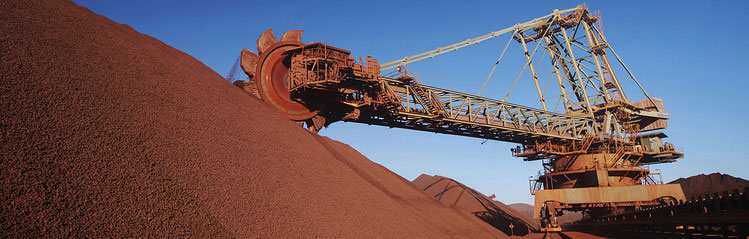
Part of the problem was indeed the wet weather. Wet iron ore sells for less than dry ore and Brazil’s heavy seasonal rains reduce production too. Iron-ore production did fall 2.2% in the quarter. Vale’s production costs rose 2% because the company hired more workers to do dredging and maintenance on its mines.
But the bigger problem was falling iron-ore prices on lower demand from Europe. Read more